|
|
Chiclayo - Peru
 Chiclayo is a city on the northern
coastal plain in Peru. It is 95 feet above sea level. The city
population is approximately 634,600 while the metropolitan area is
approximately 910,255. Chiclayo was founded in 1560 as a rural Indian
village by a Spanish priest. Until the 19th century, Chiclayo remained a
small town in comparison to the nearby city of Lambayeque. However, the
city of Chiclayo has since grown to become a major modern metropolis. It
is Peru's fourth largest city. Chiclayo is a city on the northern
coastal plain in Peru. It is 95 feet above sea level. The city
population is approximately 634,600 while the metropolitan area is
approximately 910,255. Chiclayo was founded in 1560 as a rural Indian
village by a Spanish priest. Until the 19th century, Chiclayo remained a
small town in comparison to the nearby city of Lambayeque. However, the
city of Chiclayo has since grown to become a major modern metropolis. It
is Peru's fourth largest city.
Our
Peru Travel Package
is unique and it has everything you need!
Since the city is located in a productive valley, there is strong
agriculture, such as rice production, sugar cane and cotton. Until
Peru's economic decline, the port of Pimentel served as Chiclayo's main
export line; sugar refined in Pomalca passed through Chiclayo by train
and was exported to various desinations along the Pacific Rim. However,
with the socialization of agriculture, and subsequent demise of the
Peruvian economy, Chiclayo ceased to export by sea.
Economic prosperity did not leave, however. With the construction of the
Panamerican Highway, the city became a center for commerce, due to the
fact that it has easy access to mountain passes that allow access to the
jungle, as well as being close to the sugar cooperatives.
Peru travel Agency is the perfect choice to enjoy an unforgettable experience.
Chiclayo is well known for its archaeological sites, such as Tucume,
Batan Grande and Huaca Rajada. In 1987, in Huaca Rajada (more often
referred to as Sipan), a Moche mausoleum was found. The most significant
discovery was the tomb of the El Señor de Sipan, who archaeologists have
concluded was a royal ruler from over 1600 years ago. His clothes were
adorned with jewels, gold, and silver, these artifacts can be seen in
the Tumba Real, in Lambayeque. The amount of treasure found in the tomb
rivals that found in the tomb of King Tut, as noted by the National
Geographic Magazine, in their feature article. Chiclayo is also
recognized as for its natural medicine, and for having some of the best
cuisine in Peru, especially Ceviche. Monsefu is a nearby town that
provides Chiclayo with most of the artisian artifacts and fireworks that
are for sale in the "Mercado Modelo". (This term translates to "Model
Market." Many large towns have a "Modelo," as a result of Peru's bout
with socialism)
Peru travel adventure
is amazing and interesting because there are many unique places,
mountains , beaches and etc.
Chiclayo Pictures
|
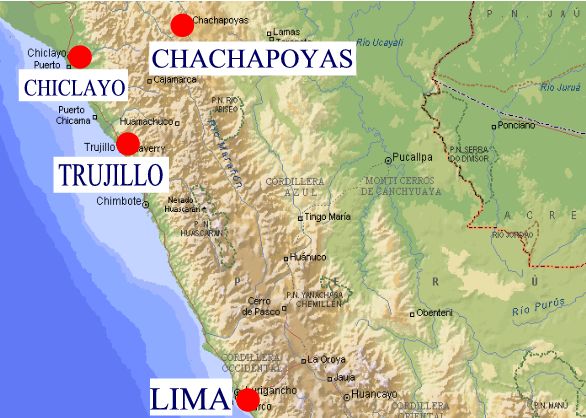
The North Tours

Area Map, click to enlarge
The
North of Peru is rich and full of interesting places such as
Trujillo, Chiclayo and the lost world of the Chachapoyas.
The Pre-Columbian Chachapoyas culture, conquered in the 15th
century by the Incas, has left a landscape scattered with
villages and burial sites which until recently had been largely
overlooked by archaeologists. Situated in the cloud forests
around the town of Chachapoyas in Peru’s northern
Amazonas Department, these sites are dominated by the mighty fortress of
Kuelap, perched majestically atop mountain-top cliffs
overlooking the verdant Andean landscape. In
Chachapoyas, remnants of the past invite discovery by the bold adventurer,
and the cultures of the present extend a friendly welcome.
In Chiclayo you will visit the tomb of the Lord of Sipan (the
richest tomb discovered in the Americas), the Valley of the 26
pyramids of Tucume and Bruning Museum where there is an
interesting collection of gold artifacts and ceramics
The pyramids of the Sun and Moon, just south of Trujillo, are
the largest structures ever put up in South America, and are
second in the Western Hemisphere only to the Pyramid of Cholula,
Mexico, in size. They formed the spiritual center of the Moche
Empire, a highly sophisticated yet mysterious culture that pre-dated
the Incas by nearly 1000 years. It is quite certain that the
Moche Indians had contact with other civilizations in the
ancient Americas, and there is good reason to believe they may
have been influenced by Asian ocean- going voyagers as well. The
Pyramid of the Moon contains a central, vaulted chamber, and the
mountain directly behind, Cerro Blanco, appears to have been
shaped by humans into a pyramid form as well. Despite their
achievements in architecture, metal-working, and ceramics (one
can still find countless pottery shards in the sands surrounding
the site), the Moche were very militaristic, and scenes from
their pottery depict ritual bloodletting and torture. They may
have evolved a system of “black” magic that aided them in their
conquests of neighboring peoples, or they may have taken
spiritual teachings from Asia and twisted their meanings into
bizarre new practices over the centuries. Huanchaco is a fishing
town where “caballitos de totora” are still used by the local
inhabitants, who venture into the cold currents of the Pacific
in these precarious-looking reed boats. This massive adobe city,
really a series of royal compounds built by the Chimu, was a
major source of gold for both the Incas, and later, for the
Spanish. Though well-looted over the centuries, gold artifacts
still occasionally appear in the drifting sands. Contacts
between Chan Chan and the Asian continent have never been proven,
but there are tantalizing hints. Pottery figures depict Asiatic
men with beards and turbans; even the name “Chan Chan” seems to
be Chinese in origin. Don’t miss the famous “honeycombs,” where
strange acoustic effects allow visitors to whisper to each other
over long distances inside the adobe structures. Also visit The
small city of Huaráz, the hub for all hiking activity and Chavin
de Huantar, the most representative Ceremonial center of the
high Peruvian Culture with 3000 years older, Chavin is
considered to be the first high Peruvian Culture.
We
offer 3 exciting tours in this area , please make a choice:
|
Package Tours |
Duration |
Highlights |
|
Sipan and Chan Chan |
3 days and 2 nights
DAILY DEPARTURES from Chiclayo
|
Tomb of the Lord of Sipan, the amazing adobe
city of Chan Chan |
|
Chachapoyas 4
days |
4 days and 3 nights
Available on Monday - Wednesday – Saturday From May to October - Upon
Request |
Chachapoyas, Kuelap citadel, Leymebamba - starting from Chiclayo
|
|
Chachapoyas 5
days |
5 days and 4 nights
Available on Wednesdays and Saturdays from May to October - Upon
Request |
Chachapoyas, Kuelap citadel, Leymebamba - starting from Chiclayo |
|
Lost
Cities of Northern Peru |
6 days and 5 nights
|
Lima, Caral, Chavin de Huantar, Huaraz,
Trujillo, Chiclayo, Tucume, Moche. |
|
Peru
Discoverer 10
days |
10 days and 9 nights |
Chachapoyas (Kuelap
fortress, burial building of Revash and Mummy museum at Leymebamba) |
|
The Lost World of Chachapoyas 10
days |
10 days and 9 nights |
Chachapoyas, Kuelap citadel, Leymebamba |
|
|
|

Mon-Fri 9 Am - 6 Pm ET
please allow pop-ups
|
| |
|
|
|

Call Centers |
North America
TOLL FREE
Monday - Friday
From 9 am to 6 pm ET1 888 671 2852 voice
1 888 671 2853 voice
Discounted Airfares
Toll Free
1-866-856-8368
1 482 247 4242 Fax |
UK customers Call
Toll Free (Freephone)
0 800 098 8450
Australia Toll Free
1-800-194078
Rest of the world call
+51 1 4443027 - 4457704 |

|
|